
Normal EMG Waveforms
A Good First Sign
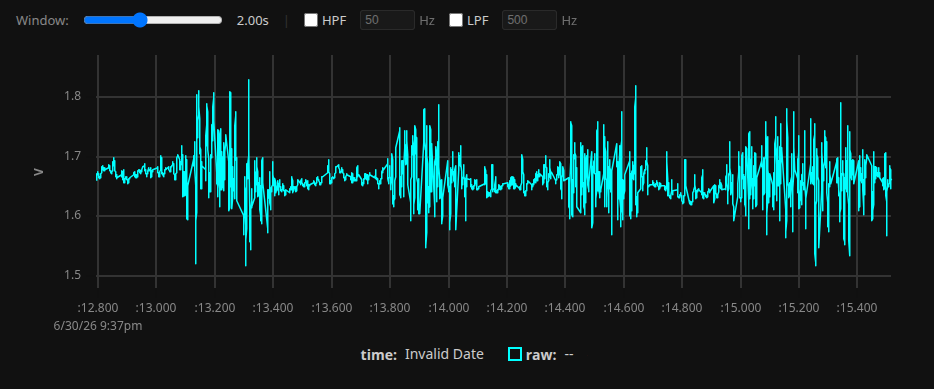
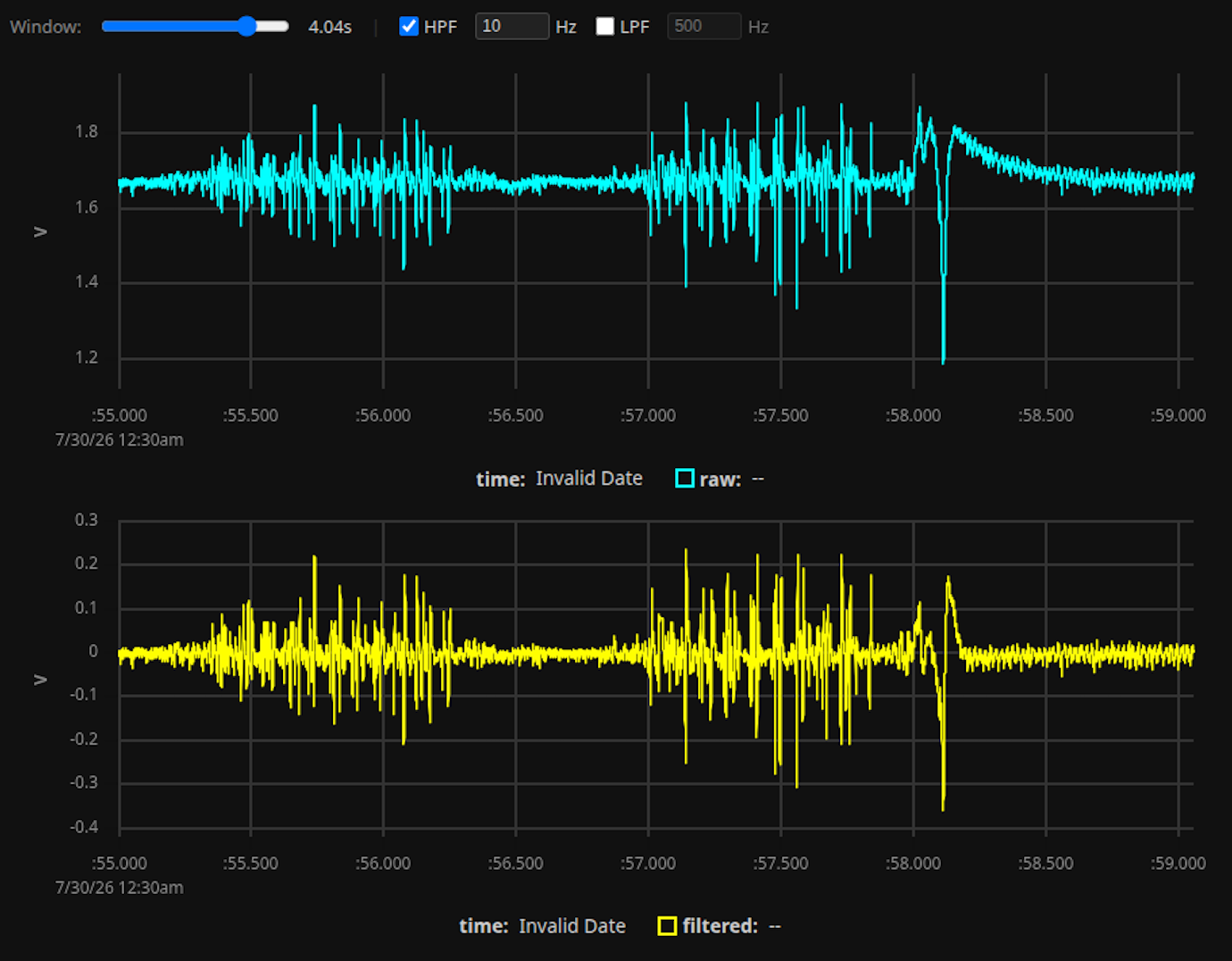
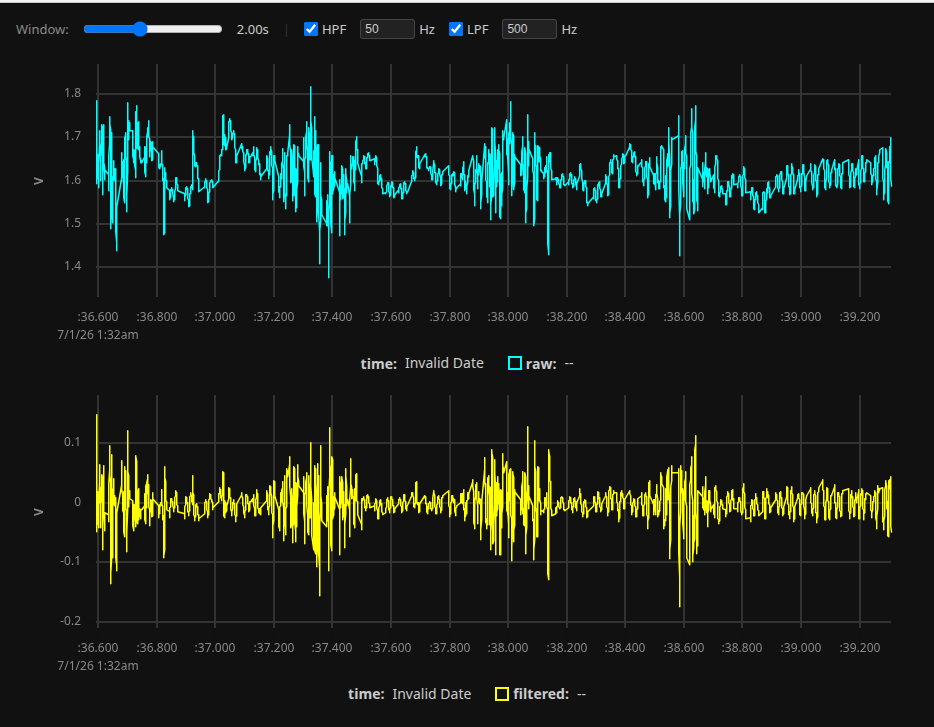
Section titled “A Good First Sign”A first waveform does not need to look perfect. The most important sign is that the amplitude increases clearly when the target muscle contracts and decreases when it relaxes.
Real Captures
Section titled “Real Captures”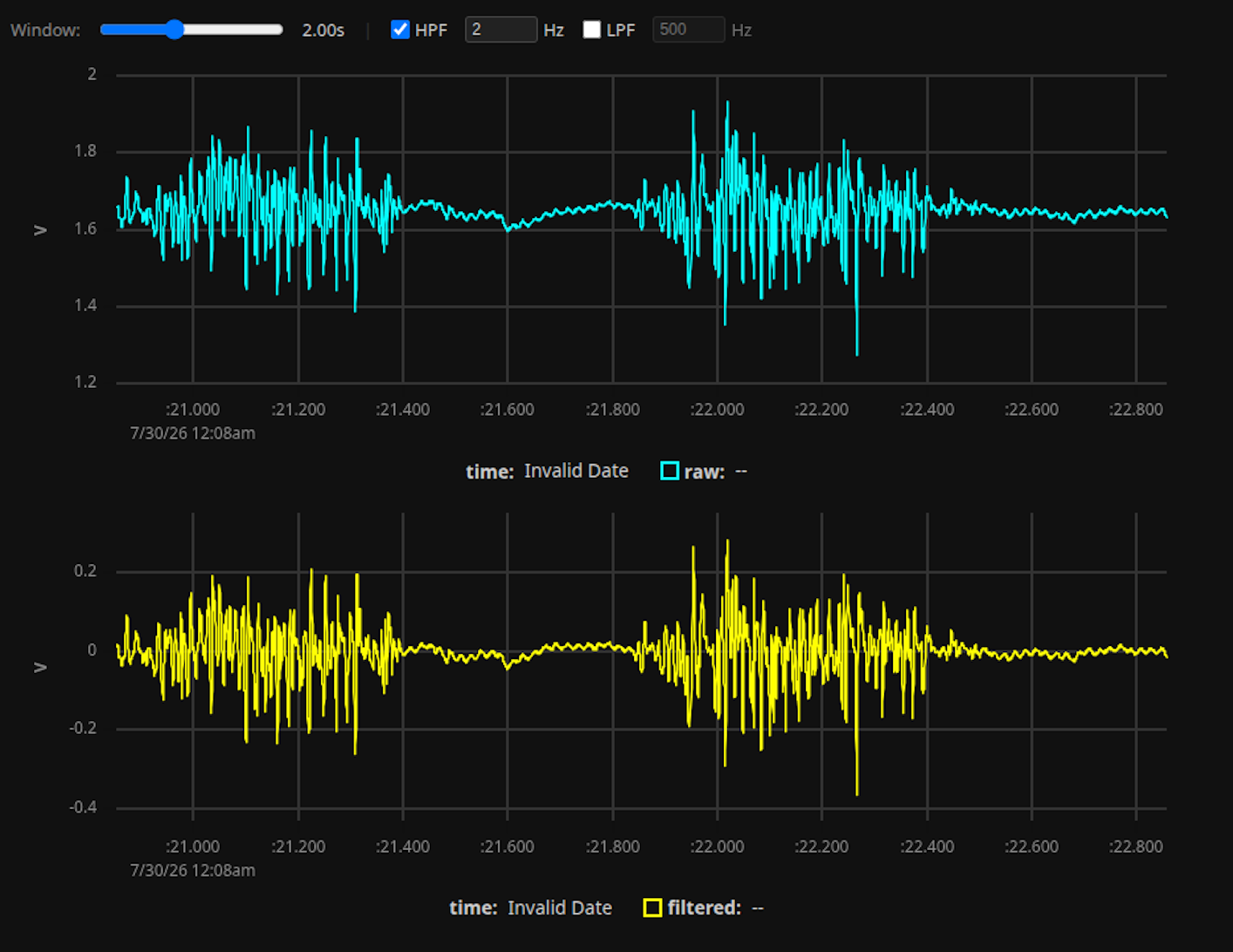
Normal Does Not Mean Smooth
Section titled “Normal Does Not Mean Smooth”Surface EMG is not a sine wave. It often looks random, high-frequency, and burst-like. For a first test, focus on whether the waveform changes with muscle activation instead of whether the line looks visually clean.
What To Watch For
Section titled “What To Watch For”- Relaxed baseline should not be fully saturated.
- Contraction should change the waveform amplitude.
- The signal should not be a perfectly flat line.
- Strong periodic noise usually means power or environment interference.
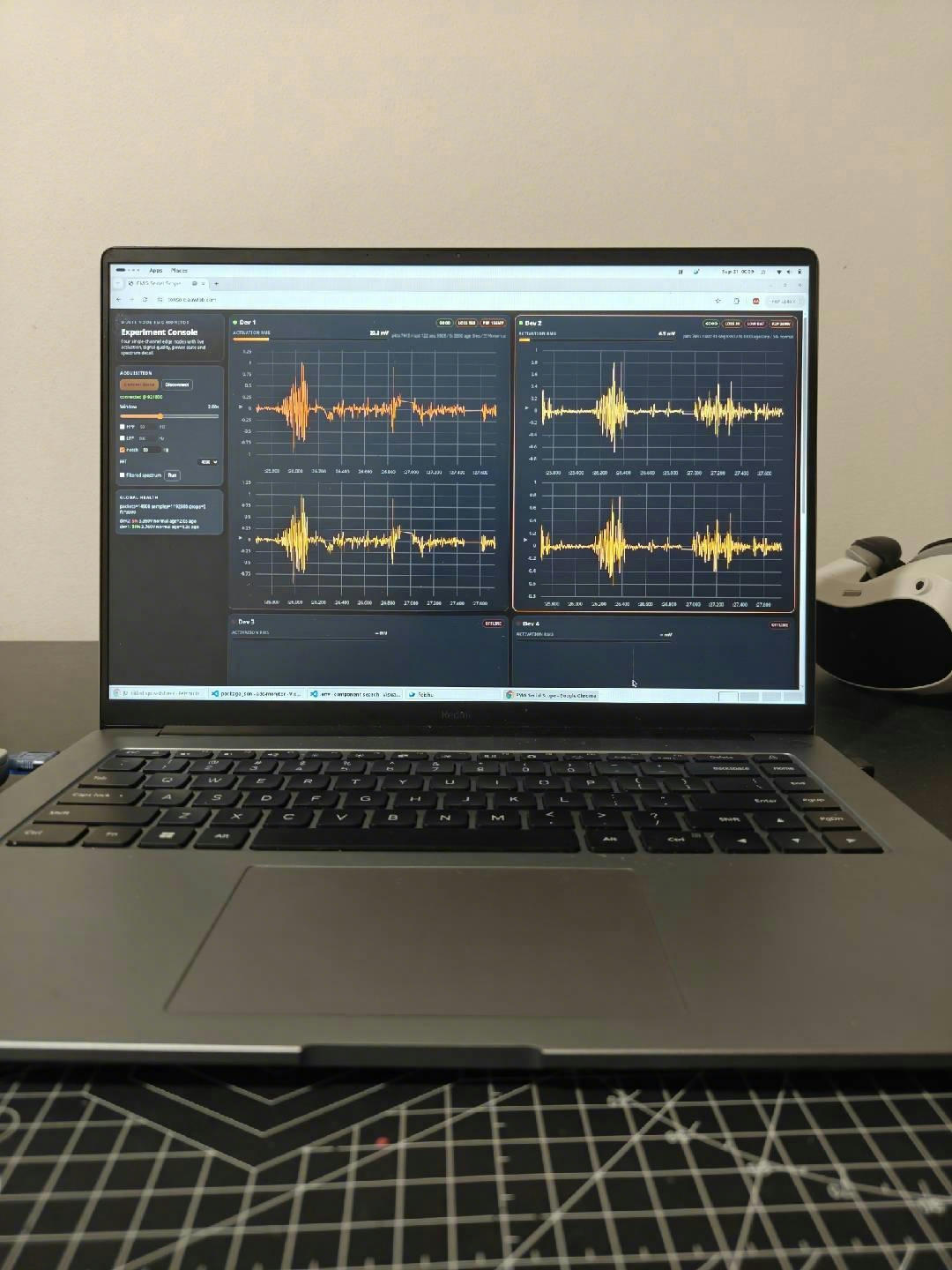
Browser-console capture: watch the waveform over a time window and compare relaxed, activated, and recovery periods instead of judging one peak.
Raw vs Filtered Waveforms
Section titled “Raw vs Filtered Waveforms”Both views are useful.
| View | What it helps you judge |
|---|---|
| Raw waveform | ADC range, clipping, fixed values, large drift, and broken wiring. |
| Filtered waveform | Whether contraction and relaxation are distinguishable after removing slow drift and unrelated noise. |
If you only look at filtered data, you may miss a front end that is already saturated. If you only look at raw data, baseline offset and drift may make the signal look worse than it is.
First-Test Checklist
Section titled “First-Test Checklist”- Check that raw ADC values are not fixed or stuck at the rails.
- Confirm that the relaxed baseline is reasonably stable.
- Clench or activate the target muscle and look for a clear amplitude increase.
- Relax again and confirm that the waveform returns to a lower level.
- If the dry-electrode result is unstable, repeat the same test with wet electrodes.
If the waveform is flat, clipped, or dominated by noise, use Noise and Flatline.