
First-time EMG Guide
Start here if this is your first time hearing about EMG. You do not need to read circuit details first.
This page answers three questions: What is EMG? What can it do? Which page should I read next?
One-sentence explanation
Section titled “One-sentence explanation”EMG is a weak electrical signal generated by muscle activity. Surface electrodes pick it up from the skin, and an EMG front end amplifies and filters it so you can see changes when you relax, clench your fist, or bend your wrist.
muscle activity → skin potential difference → EMG front end → ADC / wireless device → waveform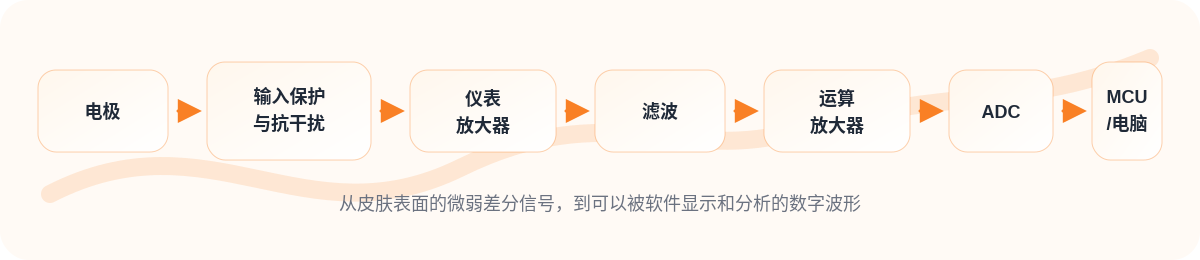
What you can do with it
Section titled “What you can do with it”- Observe forearm EMG changes during clenching or wrist motion.
- Build gesture, HCI, music-control, or game-control prototypes.
- Learn amplification, filtering, ADC sampling, serial streaming, and visualization.
- Compare wet electrodes, dry electrodes, and onboard electrodes.
- Run course projects, early research demos, and electronics experiments.
What it is not for
Section titled “What it is not for”- Medical diagnosis, treatment, monitoring, or safety-critical control.
- Measuring force directly. EMG reflects muscle electrical activity, not force itself.
- Stable measurement through clothing.
- Reliably recognizing every complex motion from one sensor alone.
What the first waveform should show
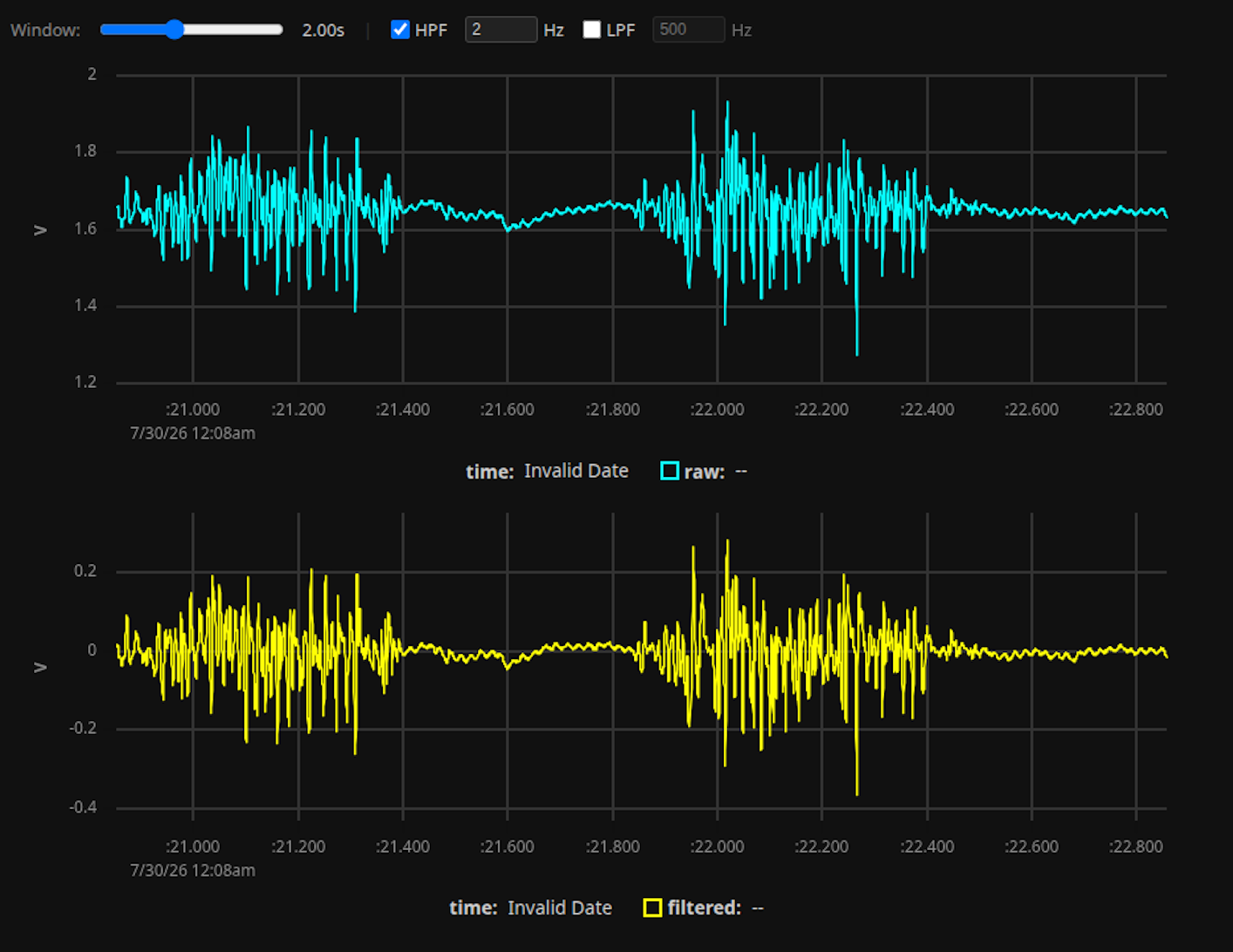
Section titled “What the first waveform should show”Your first goal is to see motion-related change.
| State | Expected result |
|---|---|
| Relaxed | Lower, quieter baseline. |
| Clench or activate muscle | Larger waveform amplitude and energy. |
| Relax again | Waveform returns to a lower level. |
Where to go next
Section titled “Where to go next”| Your goal | Next page |
|---|---|
| Choose a product | Before You Buy |
| Compare product versions | Product Comparison |
| Set up a product you bought | After Purchase Setup |
| Check technical parameters | Technical Specs |
| Fix a problem | Troubleshooting Table |